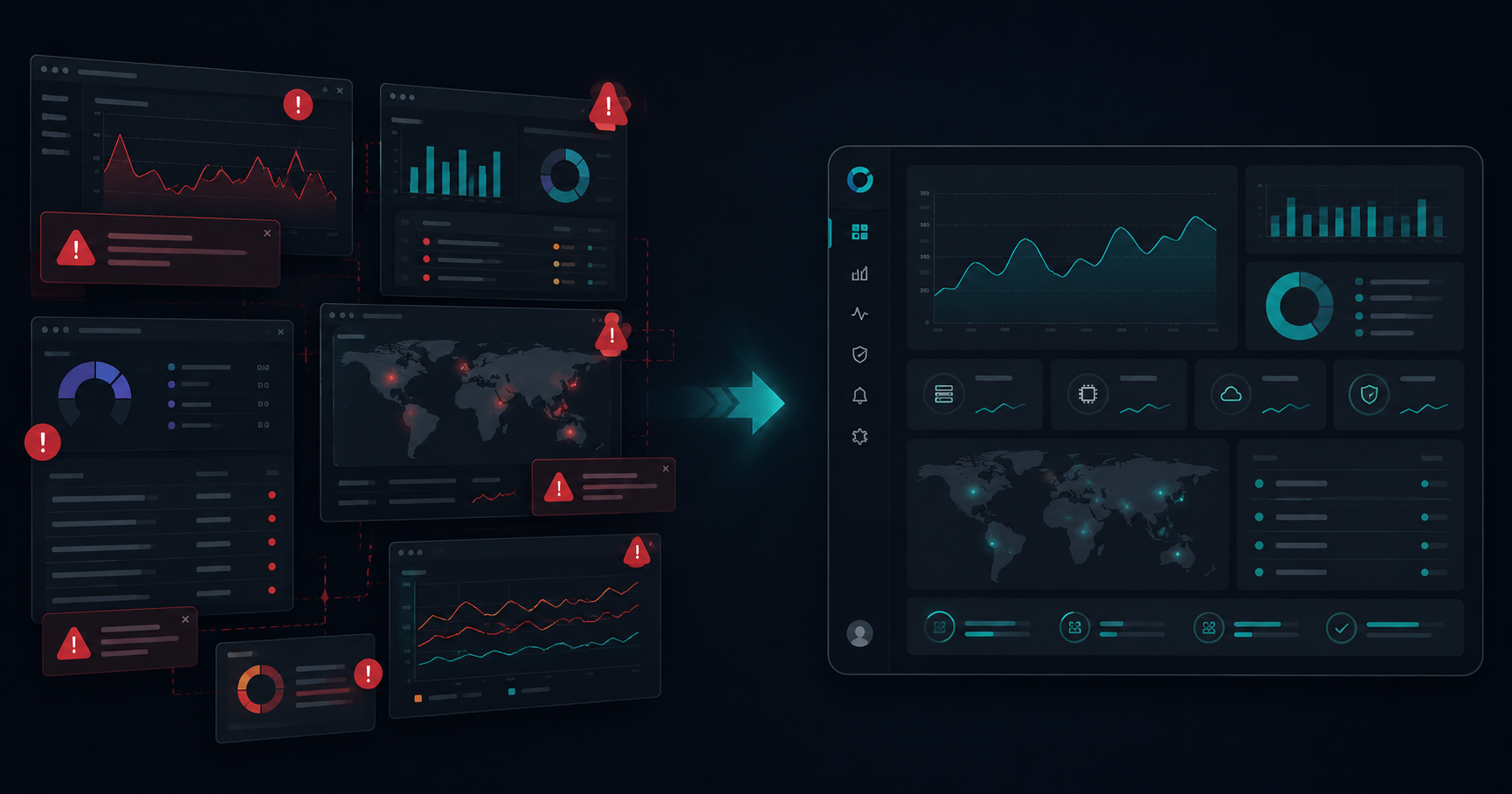
Take a Series B SaaS company. 40 engineers. $50K/month AWS bill. They’re doing everything “right” by the industry playbook:
- Datadog for monitoring ($60K/year)
- Vanta for SOC2 compliance ($30K/year)
- Wiz for cloud security ($40K/year)
- Kubecost for cost optimization ($15K/year)
Four vendors. Four invoices. Four support queues. Four onboarding processes. Four sets of documentation.
Then they hire two engineers to make it all work. Combined salary and benefits: $450K/year.
The total: ~$595K–$700K/year for infrastructure operations. And the CTO is still getting woken up at 2 AM.
If that math sounds familiar, you’re not alone. And the problem isn’t that the tools are bad. The problem is the model.
Why 72% of Companies Are Drowning in Tools
The data paints a clear picture:
- 72% of organizations use 6–15 different observability and monitoring tools
- 84% are actively consolidating or evaluating consolidation
- Average enterprise spends $300K+ on monitoring and observability tools alone
- Tool sprawl is the #2 cited challenge in cloud operations, right after skills gaps
Nobody plans for tool sprawl. It happens through a series of individually reasonable decisions.
The best-of-breed instinct. Each problem gets its own best-of-breed solution. Monitoring? Datadog. Security? Wiz. Compliance? Vanta. Costs? Kubecost. Each tool is genuinely good at its job. The problem isn’t the individual tools — it’s the collection.
The vendor lock-in slide. Each tool wants to expand its surface area. Datadog adds security. Wiz adds compliance. Vanta adds monitoring. Now you have overlapping tools with conflicting data, and nobody knows which dashboard to trust.
The team grows around the tools. You hire someone who knows Datadog. Then someone who knows Terraform. Then someone who knows Kubernetes. Each person advocates for their tool. The tool stack reflects team composition, not architectural decisions.
Integration becomes a job. Making 4–6 tools talk to each other, correlate data, and not generate duplicate alerts becomes someone’s full-time job. You’ve now hired an engineer whose primary function is managing the tools that were supposed to save engineering time.
This is the cycle: more tools require more integration, which requires more people, who introduce more tools. Each addition makes the system harder to reason about. And nobody steps back to ask whether the model itself is broken.
The Hidden Costs Nobody Adds Up
Beyond the invoices, there’s a second ledger of operational costs that rarely makes it into the budget spreadsheet.
Context switching. When an incident happens, your team checks Datadog for metrics, then CloudWatch for logs, then Wiz for security impact, then Slack for related alerts. Each tool has its own UI, mental model, and query language. Context switching between tools during an incident adds 15–25 minutes to resolution time.
Fifteen minutes doesn’t sound like much until you calculate it across every incident over a year — and factor in the downstream impact of delayed resolution on customer experience.
Finger-pointing between vendors. “The monitoring tool says the app is healthy. The security tool says there’s an anomaly. The compliance tool flagged a violation.” When three vendors have three views of the same system, incidents become debugging sessions across vendor boundaries. No vendor owns the complete picture.
Training and onboarding. Every new engineer needs to learn 4–6 tools. Onboarding for infrastructure goes from one week to one month. Tribal knowledge accumulates around tool-specific workflows. When the person who knows how to query Datadog leaves, their knowledge leaves with them.
Alert duplication and conflict. Datadog fires an alert. PagerDuty escalates it. Wiz fires a related but differently formatted alert. Vanta flags a compliance issue related to the same event. One incident, four notifications, three different severity assessments. The on-call engineer spends more time correlating alerts than resolving the actual problem.
The compounding effect. Each tool adds marginal value but multiplicative complexity. The 4th tool doesn’t add 25% more capability — it adds 40% more integration work, 30% more context switching, and 25% more alert noise.
When you add up context switching costs ($55K/year in engineering time), integration maintenance ($50K/year), and the cognitive overhead that doesn’t show up in any line item, the real cost of the 4-tool model starts approaching that $700K figure. What monitoring SaaS vendors won’t tell you about pricing is just the tip of the iceberg.
What Consolidation Actually Means
Most consolidation conversations are about reducing the number of tools. “Move everything to Datadog” or “Move everything to Grafana Cloud.” This reduces vendor count but doesn’t solve the underlying problem.
Why tool consolidation alone fails:
- You still need engineers to operate the consolidated tool
- A single tool doing monitoring + security + compliance does each one at 70%, not 100%
- The responsibility boundary hasn’t moved — you still own the outcomes
- Consolidating tools without consolidating the operational function just gives you one vendor to blame instead of four
There are actually three levels of consolidation, and most conversations stop at the first:
| Consolidation Level | What Changes | What Doesn’t |
|---|---|---|
| Tool consolidation | Fewer vendors, fewer invoices | You still operate everything |
| Platform consolidation | Unified data model, fewer UIs | You still need platform engineers |
| Function consolidation | One team owns monitoring, security, compliance outcomes | You focus on your product |
Tool consolidation is the default. Reduce four tools to two. Save some licensing cost. Still need the same engineers, still own the same outcomes.
Platform consolidation goes further. Unified telemetry, unified dashboards, unified alerting. Better, but you still need engineers who understand the platform. The operational burden shifts but doesn’t disappear.
Function consolidation is what’s actually emerging in the market. Not “buy one tool instead of four” — but “one team owns the infrastructure function, brings their own tools, and you stop thinking about it.”
The third level is where the model fundamentally changes. The team that monitors your infrastructure also secures it, also optimizes costs, also handles incidents. They bring the tools. They bring the expertise. They bring the willingness to carry the pager.
One View, One Team, One Invoice
Here’s what the $700K should actually buy:
- A single dashboard that correlates monitoring, security, and compliance data
- A team of senior engineers who have seen your problems before — across dozens of similar systems
- Incident response that doesn’t require your engineers to context-switch across four tools
- One Slack channel for all infrastructure questions — not four vendor support queues
- Continuous improvement — someone who makes the system better every month, not just maintains it
- Predictable cost that doesn’t scale linearly with infrastructure growth
The math, reframed:
| Current Model | Consolidated Function |
|---|---|
| 4 tools: ~$145K/year | Included |
| 2 engineers: ~$450K/year | Included |
| Integration maintenance: ~$50K/year | N/A |
| Context switching cost: ~$55K/year | N/A |
| Total: ~$700K/year | Fraction of the cost |
Why it’s cheaper: When one team operates one integrated function across many clients, economies of scale apply. The senior engineer who manages monitoring for your 40-person company also manages it for five other similar companies. The tooling is amortized. The knowledge is compounding. Every incident pattern seen in one system improves the response for all systems.
This isn’t a theoretical model. It’s the direction the industry is moving — from buying tools and hiring people to run them, toward buying outcomes from teams that specialize in delivering them.
The Direction Forward
The $700K infrastructure illusion persists because nobody adds up the full cost. The invoices are distributed across four vendors and two headcount lines. The hidden costs — context switching, integration maintenance, alert fatigue, onboarding overhead — never make it into the budget.
Once you do the math, it points in one direction: consolidate the function, not just the tools.
Vigil by IOanyT replaces the 4-tool, 2-engineer model with one managed service. One view. One team. One invoice. We own monitoring, incident response, and infrastructure outcomes — starting at a fraction of what you’re spending today.