Your sales team closes a $50K/year enterprise contract. Champagne. High-fives. Then the customer sends the vendor security questionnaire. Page 3: “Please provide evidence of SOC2 Type II compliance or equivalent.”
The CTO reads it. Looks at the engineering roadmap. Looks at the questionnaire. Starts moving sprint items around.
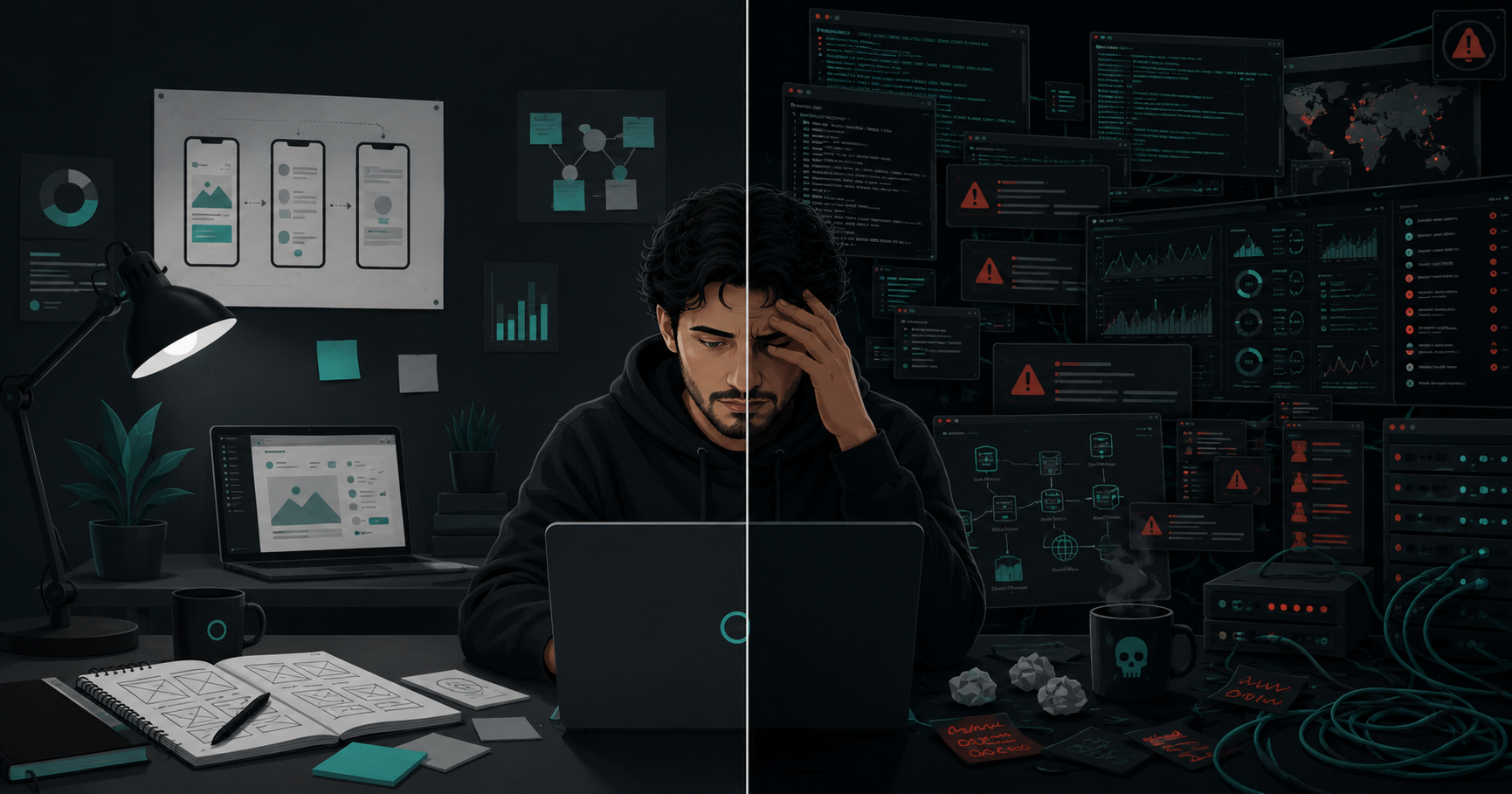
Within a week, two engineers are pulled off product work. One is writing access control policies. The other is screenshotting monitoring dashboards for evidence collection. The feature that was going to close three more deals just got pushed back six weeks.
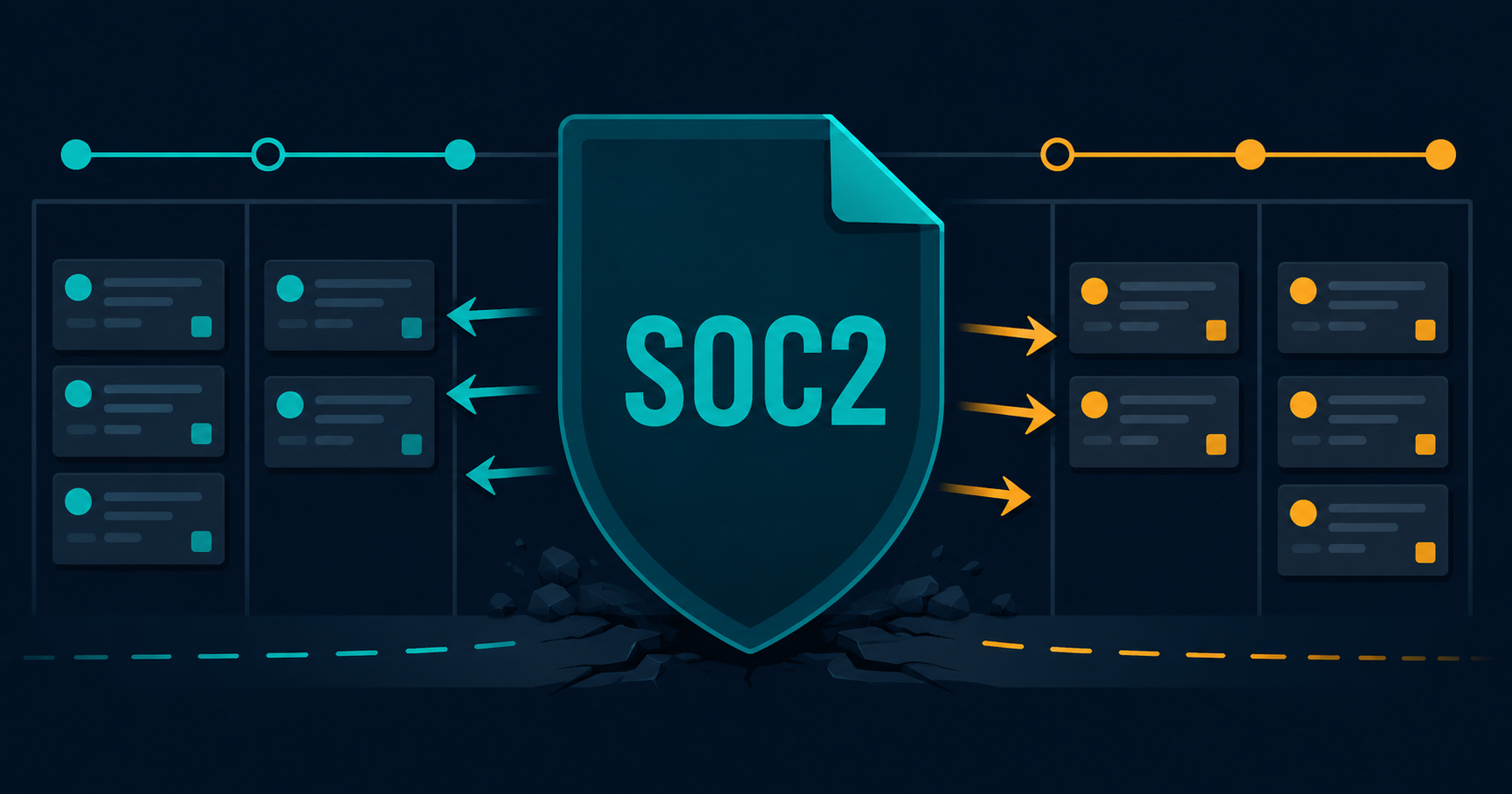
The paradox: You need SOC2 to close enterprise deals. But getting SOC2 pulls your team away from building the product that closes enterprise deals.
Why SOC2 Hits Startups Differently
Large companies have GRC (Governance, Risk, Compliance) teams. Dedicated compliance officers. Budget for Vanta or Drata. The audit is a process, not a crisis.
Startups have none of that. SOC2 hits differently for four specific reasons:
Every engineer is a compliance engineer (temporarily). There’s no GRC team. The CTO becomes the compliance lead. Engineers become evidence collectors. The sprint stops while everyone documents what they’ve been doing informally for months. The work that was happening naturally now needs to be proven, and proof takes engineering time.
Compliance controls don’t match how teams actually work. SOC2 requires “formal change management processes.” Your startup deploys 10 times a day via CI/CD. The auditor wants to see approval workflows for each deployment. Reconciling startup velocity with audit requirements is a design problem, not a checkbox exercise. Getting it wrong means either slowing down development or creating a paper trail that doesn’t reflect reality.
Evidence collection is manual by default. Screenshot monitoring dashboards. Export access logs. Document incident response procedures that exist in tribal knowledge. Write policies that describe what you already do but have never formalized. Each piece of evidence takes 1–2 engineering hours. Multiply that across the dozens of controls in the Availability and Security trust service criteria, and you’re looking at hundreds of hours.
The audit cycle never ends. Type I is a point-in-time snapshot. Type II is a 6–12 month observation period. Once you start, you can’t stop collecting evidence. Compliance becomes a permanent tax on engineering capacity — not a one-time project.
The math: Most startups report that SOC2 preparation costs 400–600 engineering hours and 3–6 months of calendar time. That’s 2–3 engineers working for an entire quarter — on compliance instead of product.
The Compliance-as-Project Trap
Here’s how most startups approach SOC2:
- Enterprise customer requests it
- CTO panics
- Buy Vanta or Drata (compliance automation platform)
- Pull engineers off product work to implement controls
- Scramble to collect evidence for 3–6 months
- Pass the audit
- Celebrate
- Realize you need to maintain this forever
- Compliance slowly degrades because nobody owns it
Steps 1 through 7 are painful but survivable. Step 9 is where the real problem begins.
Why this approach fails long-term:
It’s reactive. Compliance work happens in bursts — before audits — not continuously. The sprint before the audit window is chaos. The months after are neglect. Neither is sustainable.
It’s not integrated. Compliance tools sit alongside infrastructure tools, creating another data silo. Vanta tells you what evidence you need. Your monitoring tool has the data. Someone still has to bridge the two, manually, repeatedly.
Nobody owns it. After the initial push, compliance maintenance becomes everyone’s responsibility — meaning nobody’s responsibility. The CTO moves on to other priorities. The engineers go back to product work. The compliance posture erodes.
Controls drift. The monitoring dashboards that were evidence in January are different by June. Access controls that were documented get changed without updating the policy. Evidence gaps accumulate silently until the next audit window reveals them.
The fundamental mistake: Treating SOC2 as a project (something you do, then finish) instead of a property of your infrastructure (something that’s true because of how you operate).
Compliance as a Byproduct
What if your infrastructure was SOC2-ready by default?
Most SOC2 controls in the “Availability” and “Security” trust service criteria come down to one question: can you prove your systems are monitored, incidents are detected and responded to, and the process improves over time?
What an auditor actually wants to see:
- Monitoring coverage: Evidence that critical systems are monitored — dashboards, alert rules, coverage reports
- Incident detection: Evidence that anomalies trigger alerts — alert history, response logs
- Incident response: Evidence that alerts are responded to within SLA — response time logs, resolution records
- Continuous improvement: Evidence that incidents lead to system improvements — post-mortem records, alert tuning history
- Access controls: Evidence that access to infrastructure is logged and reviewed
The insight: If your monitoring is well-configured and operational — with someone accountable for alerting quality, incident response, and continuous improvement — you have 60–70% of your SOC2 evidence generated automatically as a byproduct of normal operations.
No screenshot collection needed. The monitoring system IS the evidence. Alert response logs ARE the proof. Post-mortem records ARE the improvement documentation.
This isn’t a theoretical reframe. It’s what happens when infrastructure monitoring is treated as a foundation rather than an afterthought. The same operational discipline that makes your systems reliable also makes them auditable.
What Infrastructure-First Compliance Looks Like
The practical shift:
| Traditional Approach | Infrastructure-First Approach |
|---|---|
| Buy compliance tool + monitoring tool separately | Monitoring generates compliance evidence |
| Engineers collect evidence manually | Evidence is generated automatically |
| Compliance reviewed before audits | Compliance is continuously verified |
| Policies written to match audit requirements | Policies describe actual operational practice |
| Evidence gaps discovered during audit prep | Gaps visible in real-time dashboards |
What you need to make this work:
- Monitoring that covers all critical infrastructure — not just the parts someone remembered to instrument
- Alerting with response tracking: who was notified, when did they respond, what was the resolution
- Automated log retention that meets audit period requirements
- Access logging that’s always on, not just before audit time
- Someone who reviews and improves the monitoring system continuously — because that’s what “operational effectiveness” means to an auditor
The key here isn’t a product. It’s an operational practice. You need someone who manages monitoring with compliance-awareness built in — not a compliance tool bolted onto monitoring after the fact.
The difference between “we have monitoring” and “our monitoring supports compliance” is the responsibility boundary. Someone has to own the operational loop — detection, response, improvement — and document it as they go. That documentation is your compliance evidence.
The Roadmap Reclaimed
SOC2 doesn’t have to eat your roadmap. It can be a natural output of infrastructure that’s monitored and operated properly. The shift is from compliance-as-project to compliance-as-property: something that’s true because of how your infrastructure runs, not something you scramble to prove before an auditor arrives.
Vigil by IOanyT manages your infrastructure monitoring with compliance evidence generation built in. Alert response logs, coverage reports, and improvement records that your auditor can verify — without pulling your engineers off product work.
Your team ships features. Your audit stays on track.