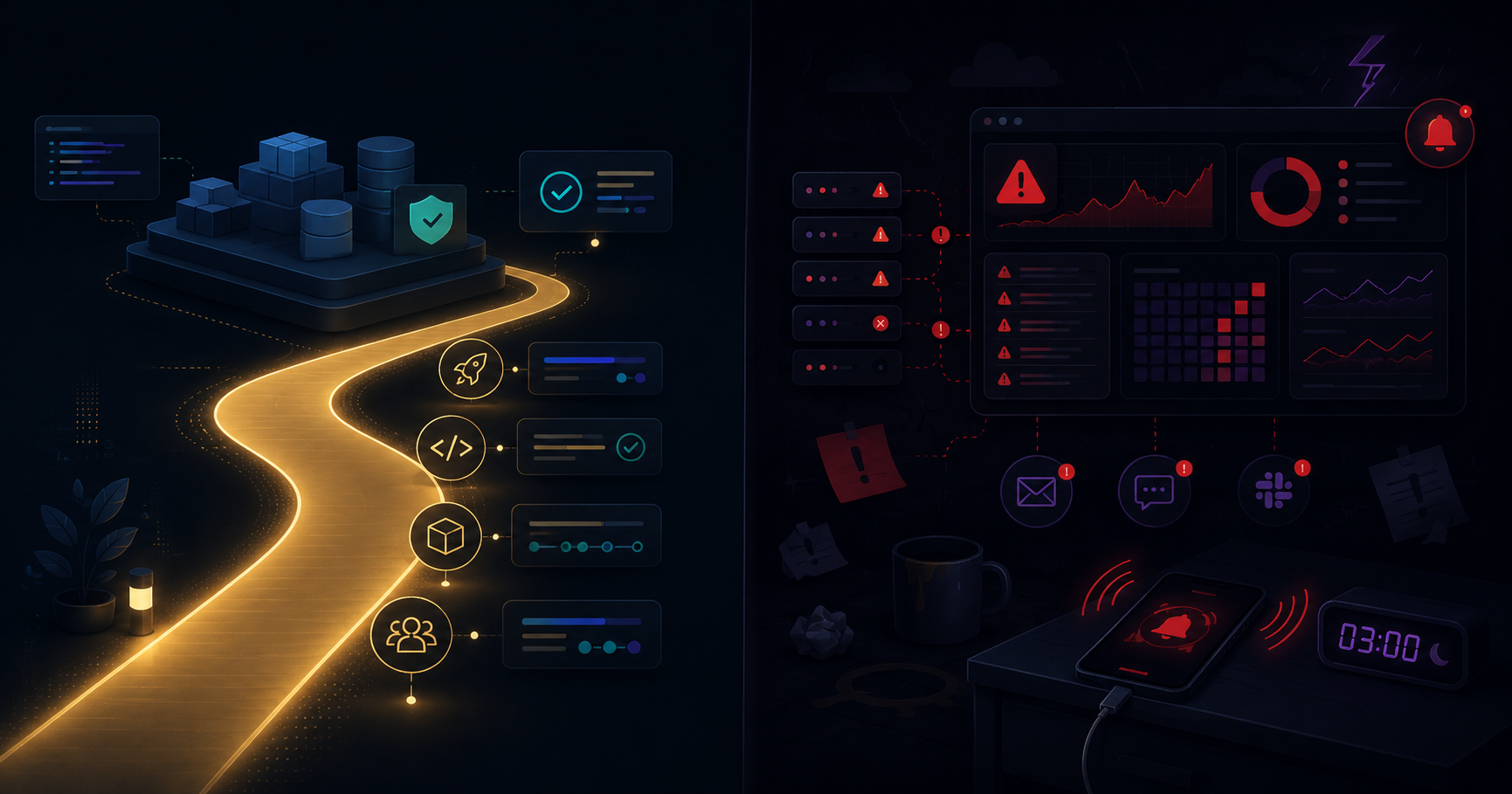
The pitch writes itself. AI that detects anomalies before they become incidents. ML models that predict failures. Automated root cause analysis that eliminates the war room. Every monitoring and DevOps vendor in 2025–2026 has some version of this slide in their deck.
The numbers sound great: 40% of DevOps teams will use AIOps as a standard component by 2026. Billions invested in AI-powered observability. Every major platform — Datadog, Dynatrace, Splunk, New Relic — now features AI prominently in their marketing.
The implicit promise: AI will reduce the operational burden. AI will let you do more with fewer people. AI will solve the infrastructure management problem.
It’s a compelling story. There’s just one problem with it.
The Paradox
Here’s the data that should concern you:
- Despite significant AI investment across the DevOps ecosystem, operational toil rose to 30% of engineering time in 2025 — up from 25% the year before
- Mean time to resolution (MTTR) has not meaningfully improved across the industry despite AI-powered detection
- Alert volume has increased, not decreased, as AI tools detect more patterns and surface more anomalies
- The number of on-call incidents has not decreased proportionally to AI adoption
The paradox, stated simply: More AI. More toil. How?
Three explanations:
AI finds more things to worry about. Better detection doesn’t reduce the response burden. It increases it. When your AI tool detects 5x more anomalies, you need 5x more human judgment to decide which ones matter. Detection without triage is noise with a PhD.
AI-powered alerts still page humans. The detection is faster, but the response chain hasn’t changed. AI detects the anomaly at 2:47 AM. The on-call engineer still gets woken up at 2:47 AM. The diagnosis, remediation, and post-mortem are still manual. AI accelerated one step in a ten-step chain.
AI can’t own outcomes. An ML model can predict that a node will run out of memory in 30 minutes. It cannot decide whether to scale the cluster, restart the service, or page the team. Those decisions require context that lives outside the data: business impact, deployment schedule, customer SLAs, cost implications. That’s judgment, not pattern recognition.
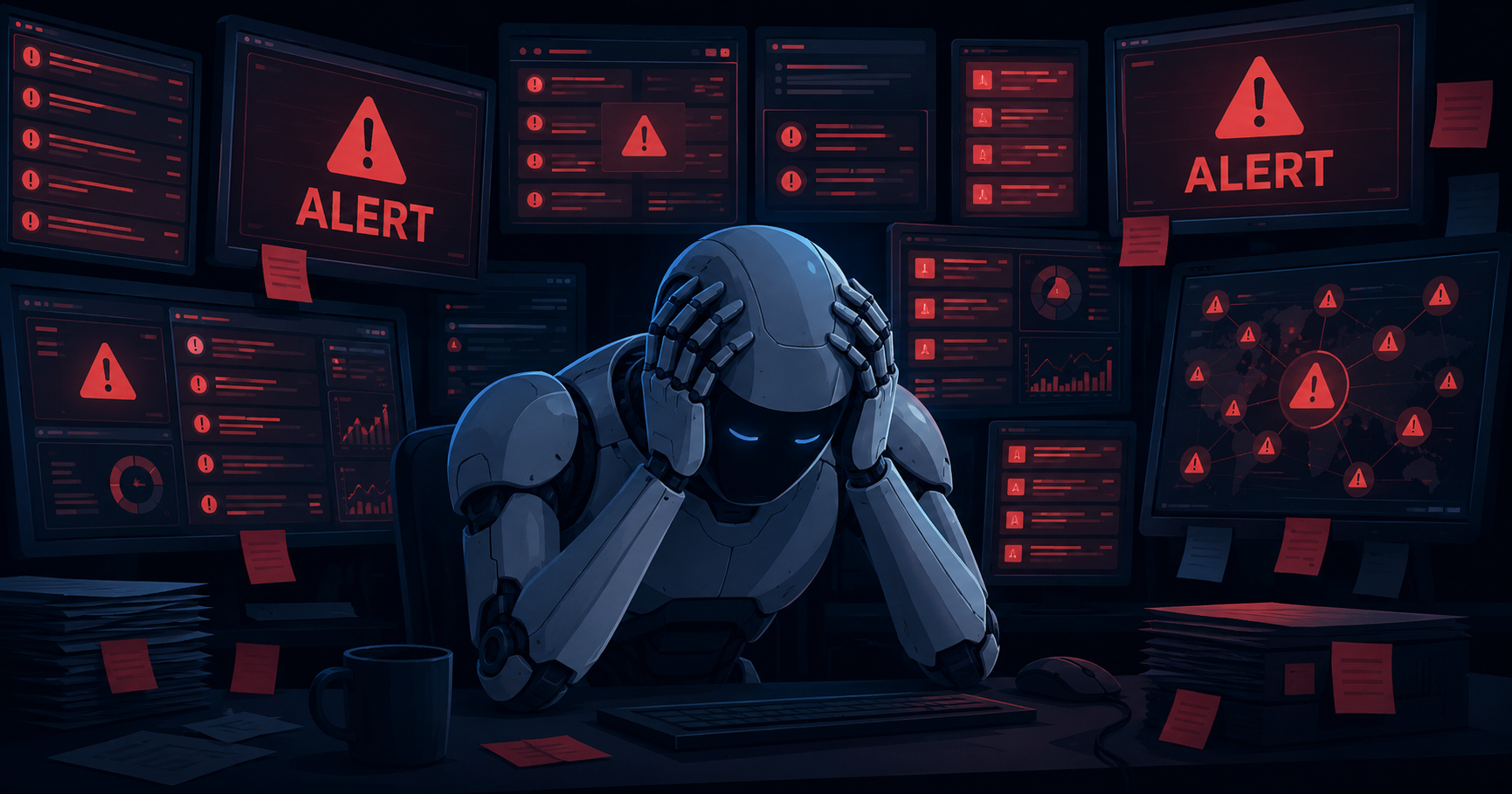
The result is the AIOps paradox: the tools got smarter, and the teams got busier. The alert fatigue problem didn’t get better with AI. In many cases, it got worse — because AI surfaces more things to be fatigued about.
The Accountability Gap
What AIOps actually automates today:
- Anomaly detection
- Correlation of related events
- Suggested root causes
- Alert grouping and deduplication
- Basic auto-remediation (restart services, scale resources)
What AIOps still leaves to you:
- Deciding which detected anomalies are real problems vs. expected behavior
- Determining business impact and priority
- Executing complex remediations that require system understanding
- Running post-mortems and feeding improvements back into the system
- Maintaining the AI models themselves (training data, false positive tuning)
- Owning the outcome: was the system actually reliable this month?
The pattern should look familiar. AIOps is repeating the same structural mistake that monitoring SaaS made. The vendor ships the capability. The customer is expected to provide the judgment, context, and accountability to make it useful. The responsibility boundary is in the same wrong place — just with fancier technology on the vendor’s side.
The detection got faster. The diagnosis is still manual. The remediation is still yours. The improvement loop still depends on someone having time to close it. Nothing fundamental changed about who owns the outcome.
The key distinction: “AI-powered” means the tool uses AI. “AI-orchestrated” means AI is part of an operational model where someone owns the outcome end-to-end. Those two things sound similar. They are structurally different.
What AI Should Actually Do in Infrastructure
The right role for AI isn’t replacing human judgment. It’s amplifying it. Here’s what that looks like in practice:
Detection → Triage (AI):
- AI detects the anomaly
- AI correlates it with recent changes, related services, historical patterns
- AI classifies severity based on business impact, not just metric thresholds
- AI determines: is this a human-now problem, a human-later problem, or a no-human problem?
That last classification is where most AIOps tools stop. They detect. They might correlate. They surface everything to humans and let the humans figure out the rest. The critical triage question — “does this need a human right now?” — is answered by the person who just got woken up, not by the system.
Triage → Action (Human judgment, AI-assisted):
- For human-now: AI provides a context package — what changed, what’s affected, what worked last time this happened
- For human-later: AI creates a structured ticket with full context for morning review
- For no-human: AI executes pre-approved remediation (scale, restart, failover) and logs the action
Action → Improvement (Human + AI feedback loop):
- Every incident feeds back into the system
- AI learns which alerts led to action and which were noise
- Humans review the AI’s triage decisions weekly and correct misclassifications
- The system gets better because someone is accountable for making it better
The difference: this isn’t AIOps as a product feature bolted onto a monitoring tool. It’s an operational model where AI handles the routine, humans handle the judgment, and someone owns the outcome of the combined system.
AI-Powered vs. AI-Orchestrated
The distinction that matters:
| AI-Powered | AI-Orchestrated | |
|---|---|---|
| AI’s role | Feature of the tool | Part of an operational system |
| Who trains the model | The vendor (generic) | Tuned to your infrastructure |
| Who triages AI output | Your team | Included in the service |
| Who acts on detections | Your team | Senior engineers (included) |
| Who improves the system | Your team (if they have time) | Built into the operational model |
| Who owns the outcome | You | The provider |
| What you’re buying | Smarter alerts | Reliable infrastructure |
The market is converging on AI-powered. Every tool adds AI features. That’s table stakes. The differentiator is not whether AI is involved — it’s who closes the loop between AI detection and operational improvement.
A monitoring tool that uses AI to detect 50 anomalies per day is AI-powered. A managed service where AI triages those 50 anomalies, a senior engineer handles the 3 that matter, and the system learns from each one — that’s AI-orchestrated.
The future of infrastructure management: Not AI replacing humans. Not humans ignoring AI. An orchestrated system where AI handles volume, humans handle judgment, and accountability is structural — not aspirational.
The Force Multiplier
AI is a force multiplier. But a force multiplier with no one holding it accountable is just faster chaos.
The problem was never detection speed. It was who acts on what’s detected, and who improves the system afterward. AI doesn’t change that equation. It amplifies whatever model is already in place — for better or worse.
If your model is “tool detects, team scrambles,” AI gives you “tool detects faster, team scrambles sooner.”
If your model is “detection → triage → action → improvement, with accountability at every step,” AI gives you “faster detection, smarter triage, better context, continuous improvement.” The model determines whether AI helps or just adds noise.
Vigil by IOanyT is AI-orchestrated, not just AI-powered. AI handles the routine. Senior engineers handle the judgment. We own the outcome. That’s not a product feature. It’s an operational commitment.
Your infrastructure gets smarter every month because someone is accountable for making it smarter.